
AI Support Triage That Answers Clients Within Minutes
Summary
Support requests and automated error reports arrive by email, and someone has to read each one, decide what it is and pass it on before any real work can start.
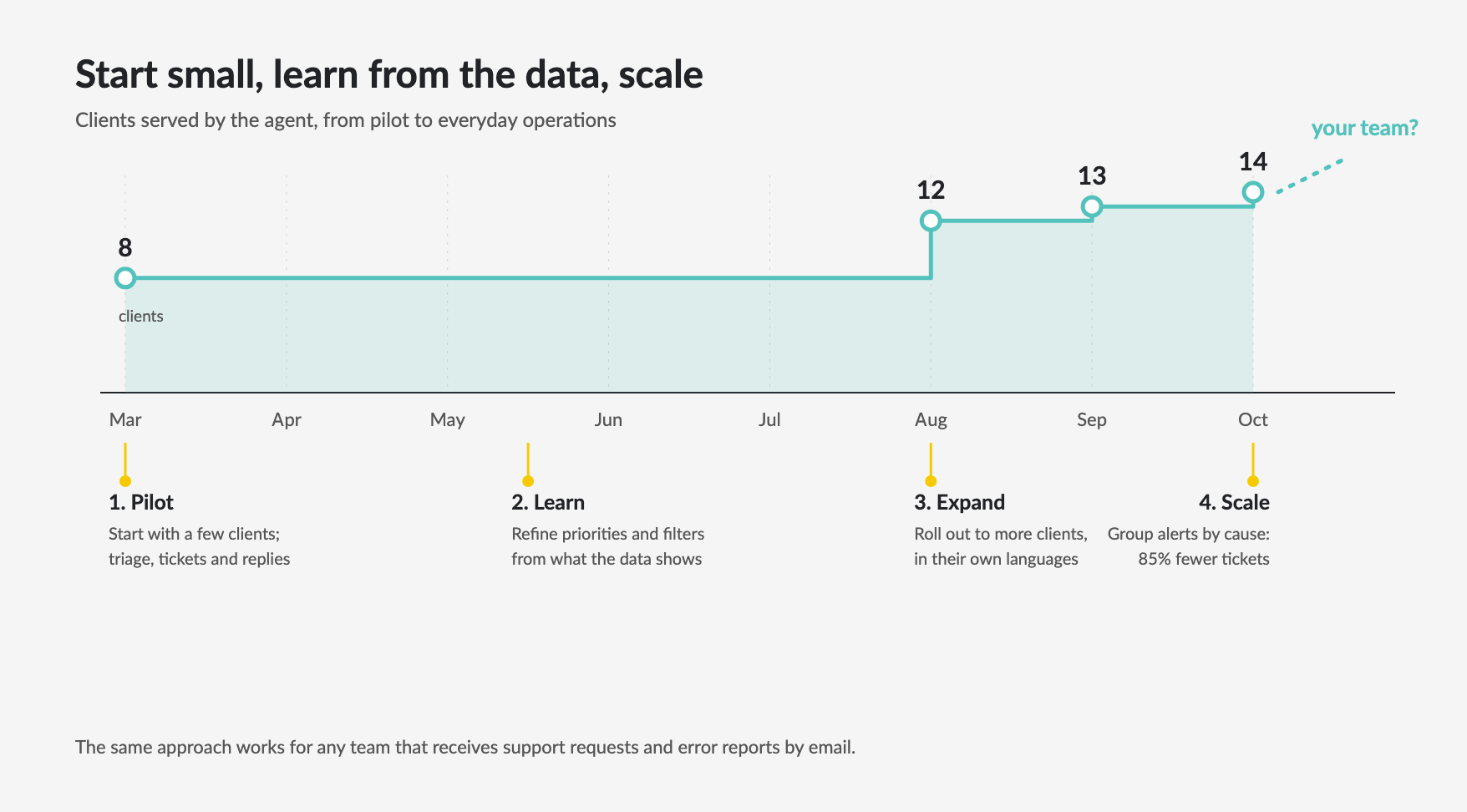
We built an AI support agent to take over that first pass, piloted it with a small group of clients and rolled it out gradually. With the first 14 clients it has already handled 161 support emails and 5,257 website error emails. Every client gets an answer with a ticket reference within minutes, and 81% of error alerts are recognized as noise without anyone having to open them.
It shows that this kind of automation works in day-to-day support. We keep improving the agent with every email it handles, and we can help your team set up something similar.
The Challenge: Inboxes That Grow Faster Than the Team
Support work starts in an inbox. A client reports a broken form, asks for a content change or mentions a new idea. In between those messages, websites send automatic error reports: thousands of them, most caused by bots, scanners or harmless glitches, a few signalling a real problem.
Sorting this by hand has three costs:
- Slow first responses. A client writing in the evening or at the weekend waits until someone is back at their desk to hear that the message has arrived.
- Developer time spent reading, not fixing. Each email has to be opened, understood, prioritized and turned into a ticket, often with the key details (which page, which browser, what the error said) missing.
- Alert fatigue. A single bot scan can turn a handful of bugs into hundreds of alerts. Important errors are easy to miss in that kind of noise.
Two Workflows, One Agent
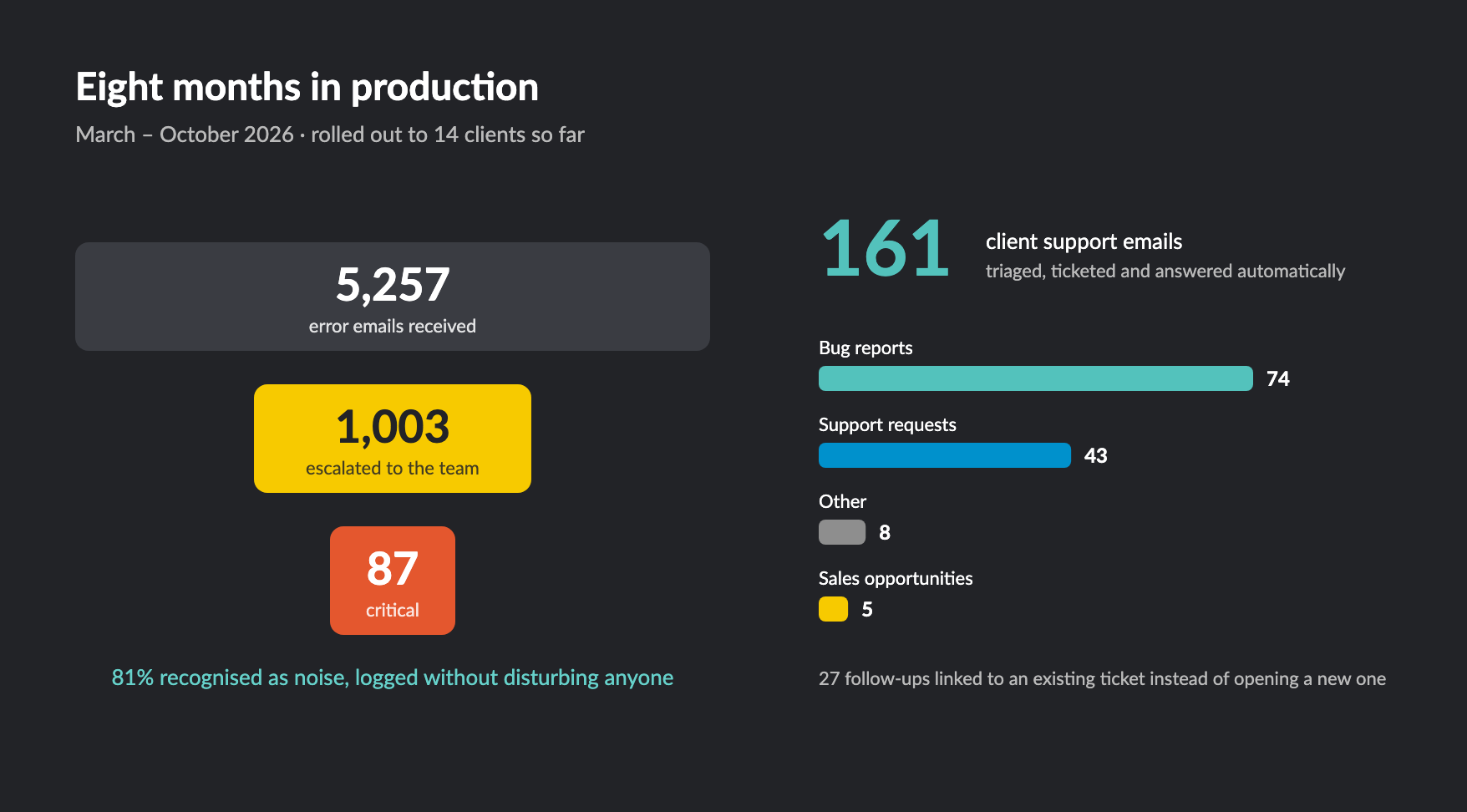
Client support emails
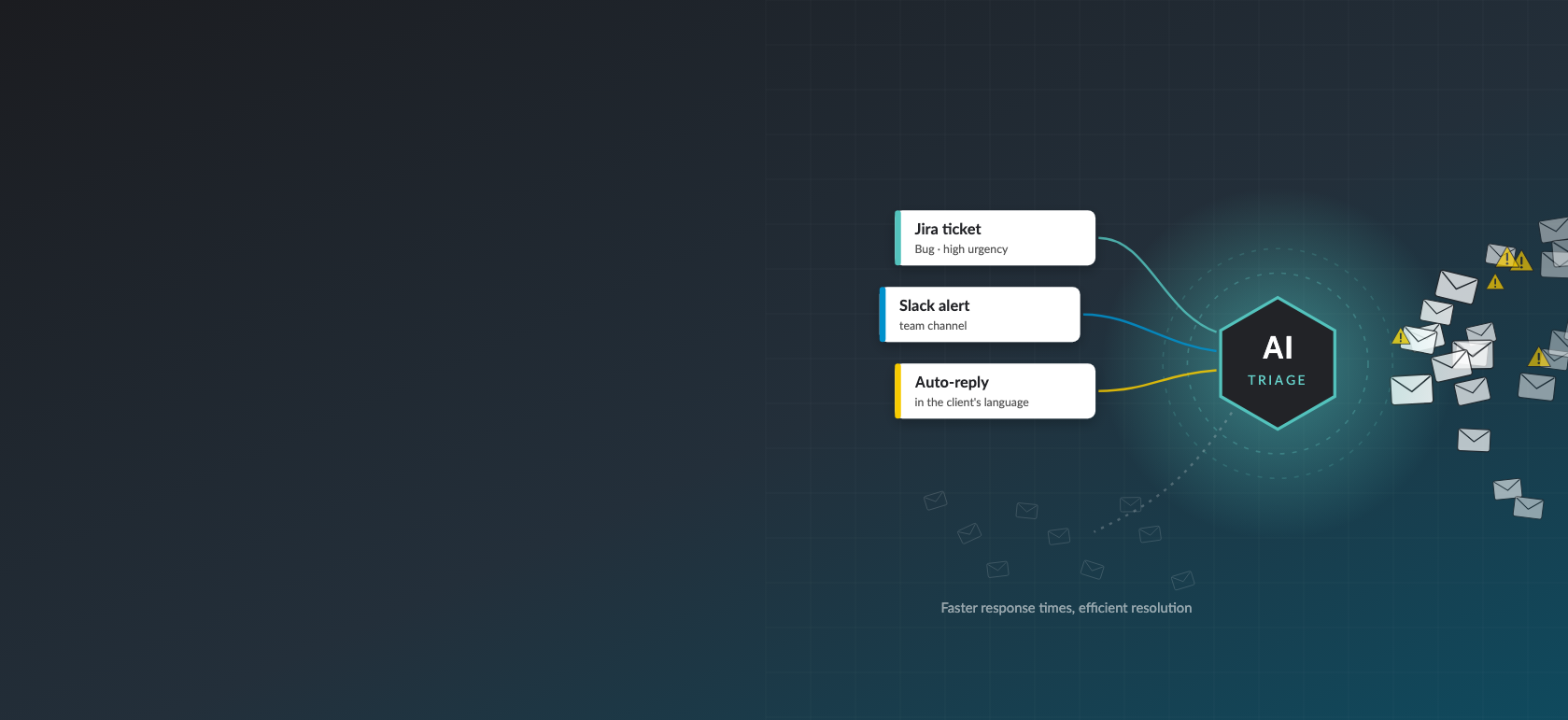
The agent reads every client inbox every five minutes. It recognizes what each message is (a bug report, a support request, a sales opportunity) and how urgent it is, picks out the details a developer needs, and translates messages written in languages the team does not read. It then opens a ticket, alerts the right project channel and replies to the client in their own language with the ticket reference. Follow-ups to an existing issue are added to the existing ticket instead of opening a new one.
Website error emails
Error reports come from Error & Exception Mailer, the Drupal module BRAINSUM created and maintains. For each report, the agent assesses the risk, from "ignore" to "critical". It weighs whether real users were affected and never dismisses an error that breaks a form visitors rely on, such as contact or login. Repeated reports of the same underlying error are grouped into one issue, and alert storms are throttled, so the team gets one clear signal per real problem.
Start Small, Learn From the Data, Scale
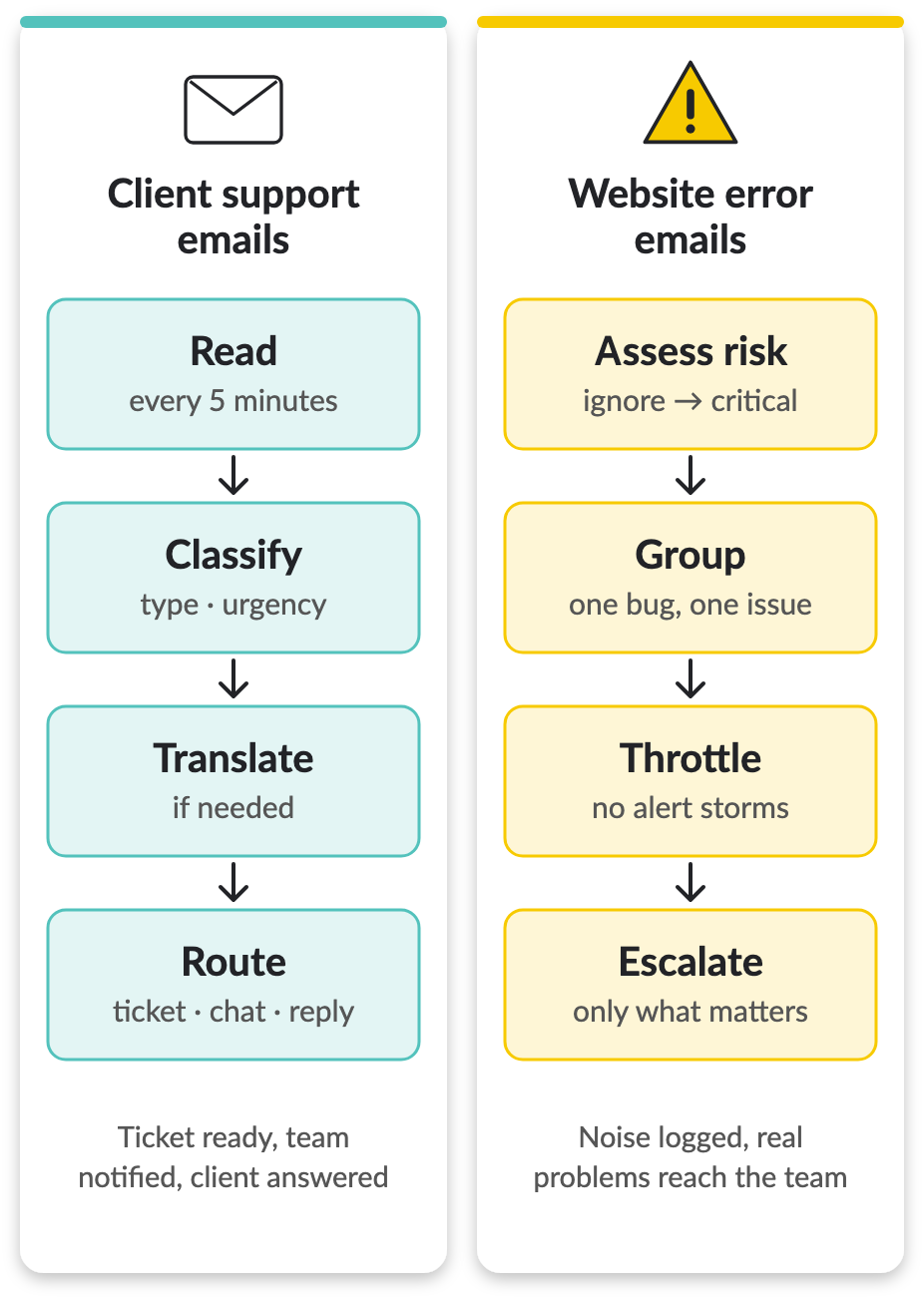
We did not switch the agent on for everyone at once. We started with a pilot group, measured every decision it made and widened the rollout as the results held up. Every email it handles is also data, and that data shows where the agent can do better:
- Smarter priorities. Follow-ups land on the existing ticket, and errors that affect signed-in users are rated more serious than those only bots trigger.
- Less clutter. Automated senders and newsletters are filtered out before they reach anyone.
- The client's language. Each client is answered in the language they work in.
- A smarter model, still very cheap. We are not tied to one AI vendor. When a more capable model became available, we switched provider and model, moving from OpenAI to Anthropic's Claude, without changing anything else. The agent got noticeably better at judging risk and reading context, while AI usage still costs only 2–3 USD a month.
- Alerts grouped by cause. When one bot scan turned a handful of bugs into hundreds of alerts, the agent learned to see one problem behind many reports, cutting alert tickets by 85% while every real problem still reaches the team.
This is not the end of the road. Each new client brings new kinds of messages, and the agent keeps getting more accurate as it learns from them.
The Results & Business Impact
With 14 clients on board, the agent has proven itself in everyday support. It does not replace the support team: it removes the reading, sorting and copying that came before the real work, so people start every issue with a prioritized ticket that already holds the facts.
Clients notice the difference first. Every message is acknowledged with a ticket number, in their language, within minutes, day or night.
161 Client Emails Handled
74 bug reports, 43 support requests and 5 sales opportunities classified, ticketed and answered automatically. 40 were flagged as high or critical urgency.
5,257 Error Emails Triaged
4,254 of them (81%) were recognized as noise and logged without disturbing anyone. 1,003 were escalated, including 87 critical issues.
85% Fewer Alert Tickets
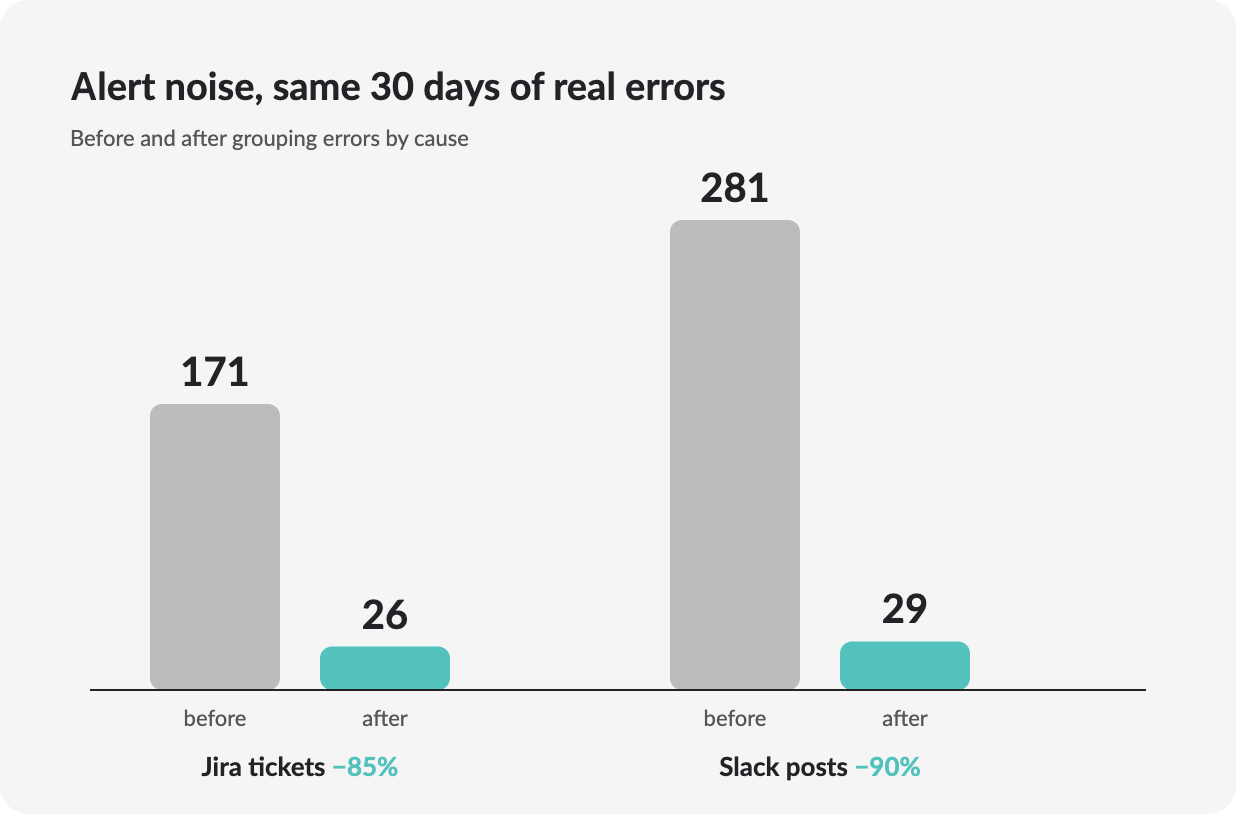
Grouping errors by their cause cut tickets from 171 to 26 and chat alerts from 281 to 29 over the same 30 days of real errors, while every distinct problem still reached the team.
Replies in the Client's Language
Messages in other languages are translated for the team, and every client is answered in the language they work in.
2–3 USD a Month in AI Costs
Switching to a more capable model made the agent smarter without making it expensive: the AI usage behind all of this costs 2–3 USD a month.
Less Noise, Same Coverage
This chart is the self-improvement loop at work. The agent's own data showed that one bot scan could turn a handful of bugs into hundreds of alerts. We used that data to teach the agent to group errors by their cause, then replayed 30 days of real error reports to prove the change before rolling it out: 26 tickets instead of 171 and 29 chat alerts instead of 281, with every distinct problem still reaching the team.
Measure, learn, optimize, repeat: every improvement to the agent follows the same loop. For clients, that means faster fixes for the problems that matter. For developers, an alert channel worth paying attention to.
Want an Agent Like This for Your Team?
If your team handles support requests or error reports by email, the same approach can work for you. We can help you start with a pilot, connect the agent to the tools you already use, such as your ticketing system and team chat, and keep improving it with your own data.

