

AI CONTENT REVIEW AND MODERATION
Keep hundreds of pages to your style guide without re-reading them, and let a model read user comments before anyone else does. Both run on our Drupal AI demo site.
Quality control that keeps up with your content
- Content review for editors: every page scored against your own criteria, with a written verdict and concrete rewrites. Editors see the score while they write; editorial leads see the whole site in red, amber and green.
- Pre-moderation for user content: comments, submissions or any other text field checked in context before publication. A moderator only sees what the model held back, together with the reason.
- Rules you own: criteria, thresholds and the examples the model learns from are configuration. Hard rules can stay deterministic, instant and free.
Both run on aidemo.brainsum.com, our public Drupal AI demo site, each with a step-by-step walkthrough. Comment moderation can be tried without logging in.
Every page scored against your style guide
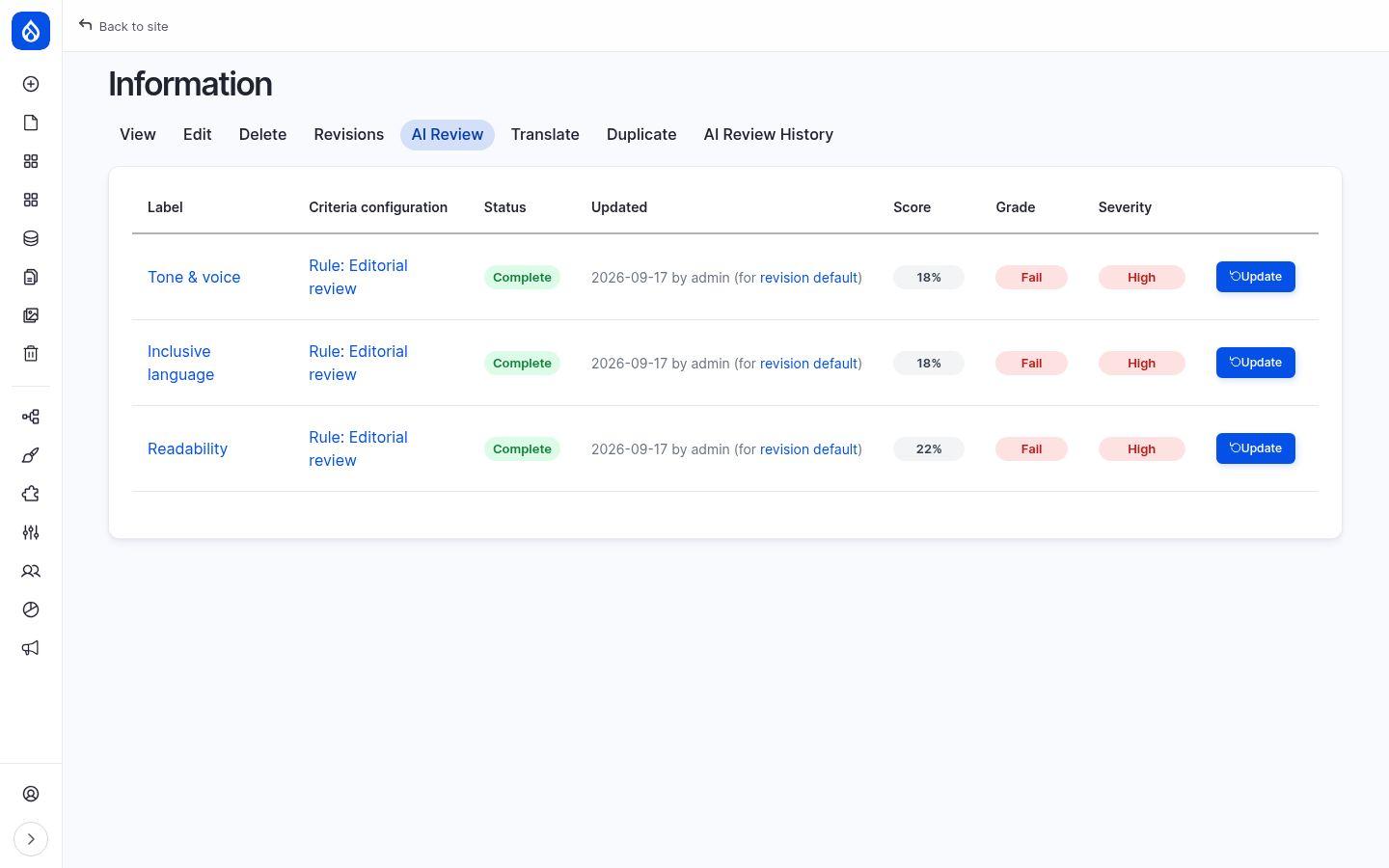
The demo site's style guide fits on one page: warm, plain, inclusive, written for the reader. Every standard page carries an editorial review with three criteria, tone and voice, inclusive language and readability, each scored 0 to 100 against calibrated examples. An editor opens the AI Review tab, clicks Review, and gets a score and a grade within seconds, without leaving the page.
The grade is not the model's opinion. Pass and warn thresholds are set on the review rule, so the bar is yours to move, and a criterion for legal wording, accessibility or SEO can be added in the admin UI without writing code.
A verdict with rewrites, not a red flag
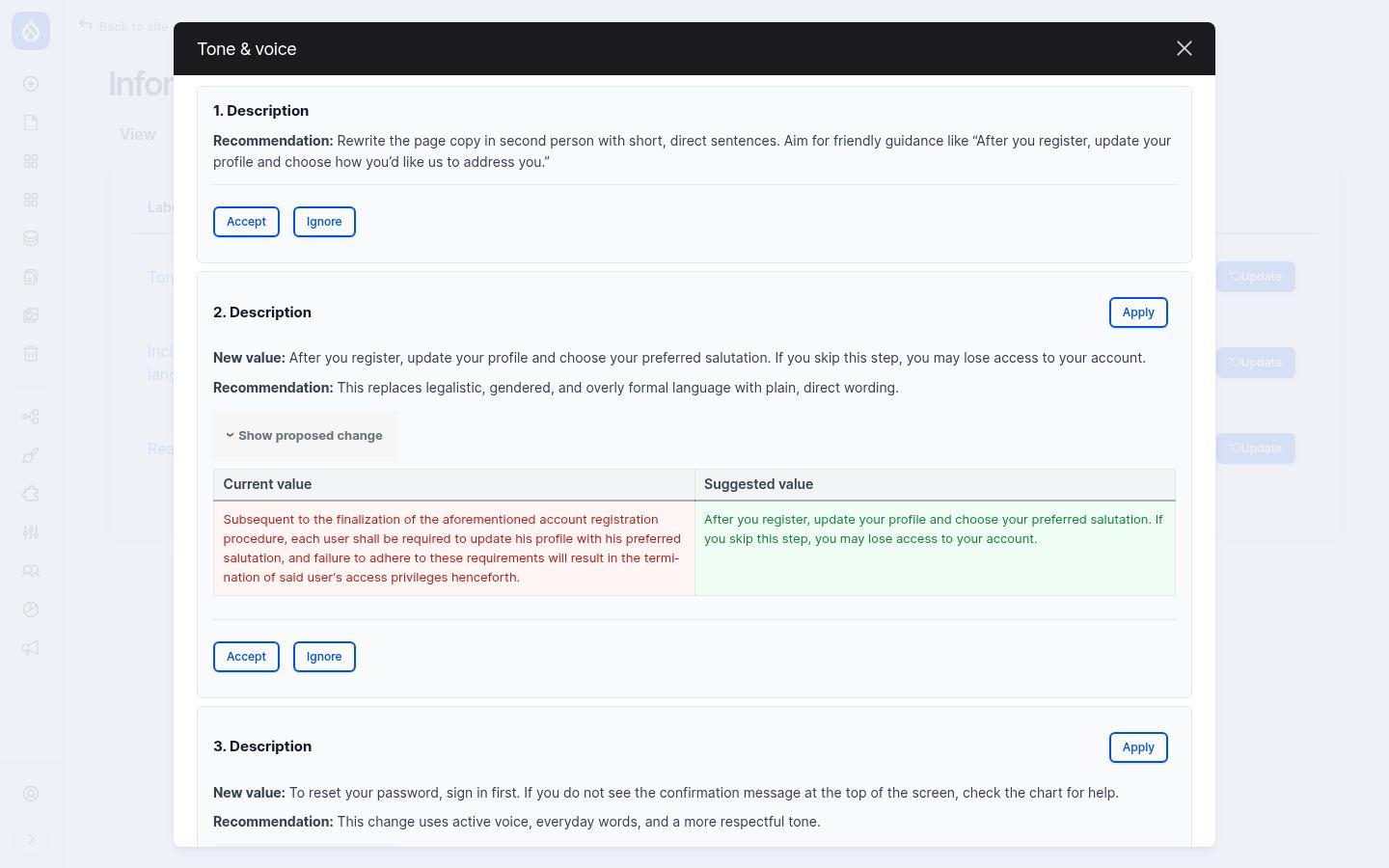
Each result explains itself. It quotes the page back and says what is wrong with it, then lists numbered recommendations: a general instruction and paragraph-by-paragraph rewrites, shown side by side with the current text in red and the suggestion in green. Editors accept, ignore or apply each one.
Accepted recommendations follow the page into the editor as an improvement plan. A re-run grades the page as it stands, so the reviewer never rubber-stamps its own suggestions. On the demo, a page goes from 18% to 86% on tone and voice in about ten minutes, with every word chosen by the editor.
The whole site at a glance
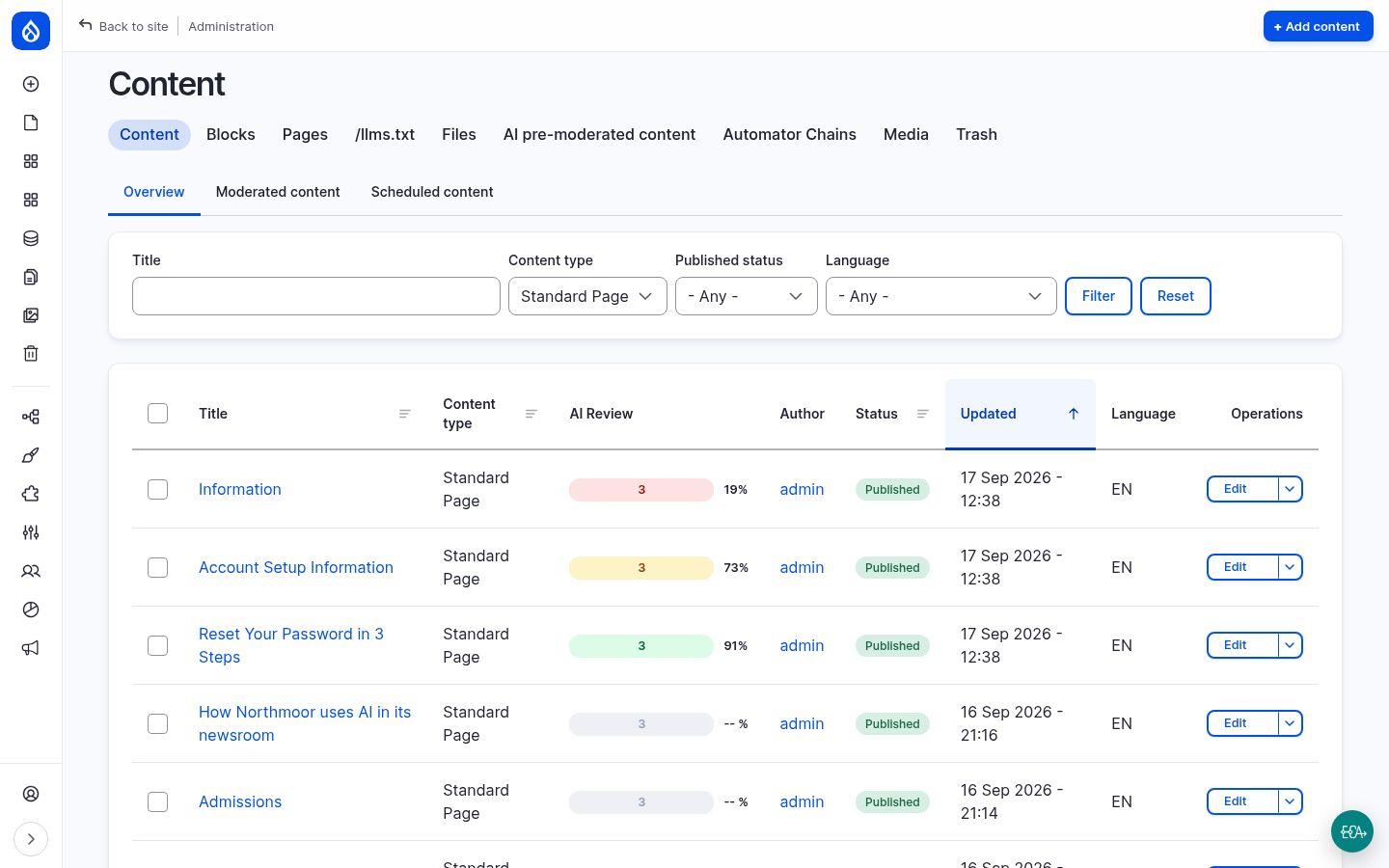
Editorial leads get a red, amber and green column on the content list, one pill per page, with the per-criterion breakdown on hover. The same pill sits in the top bar of every page an editor opens. Every review is kept on record per revision, so you can see how a page's score moved over time and who changed what in between.
See AI Content Review on the demo site (needs a login on the demo; the walkthrough explains).
Comments read by the model before they are published
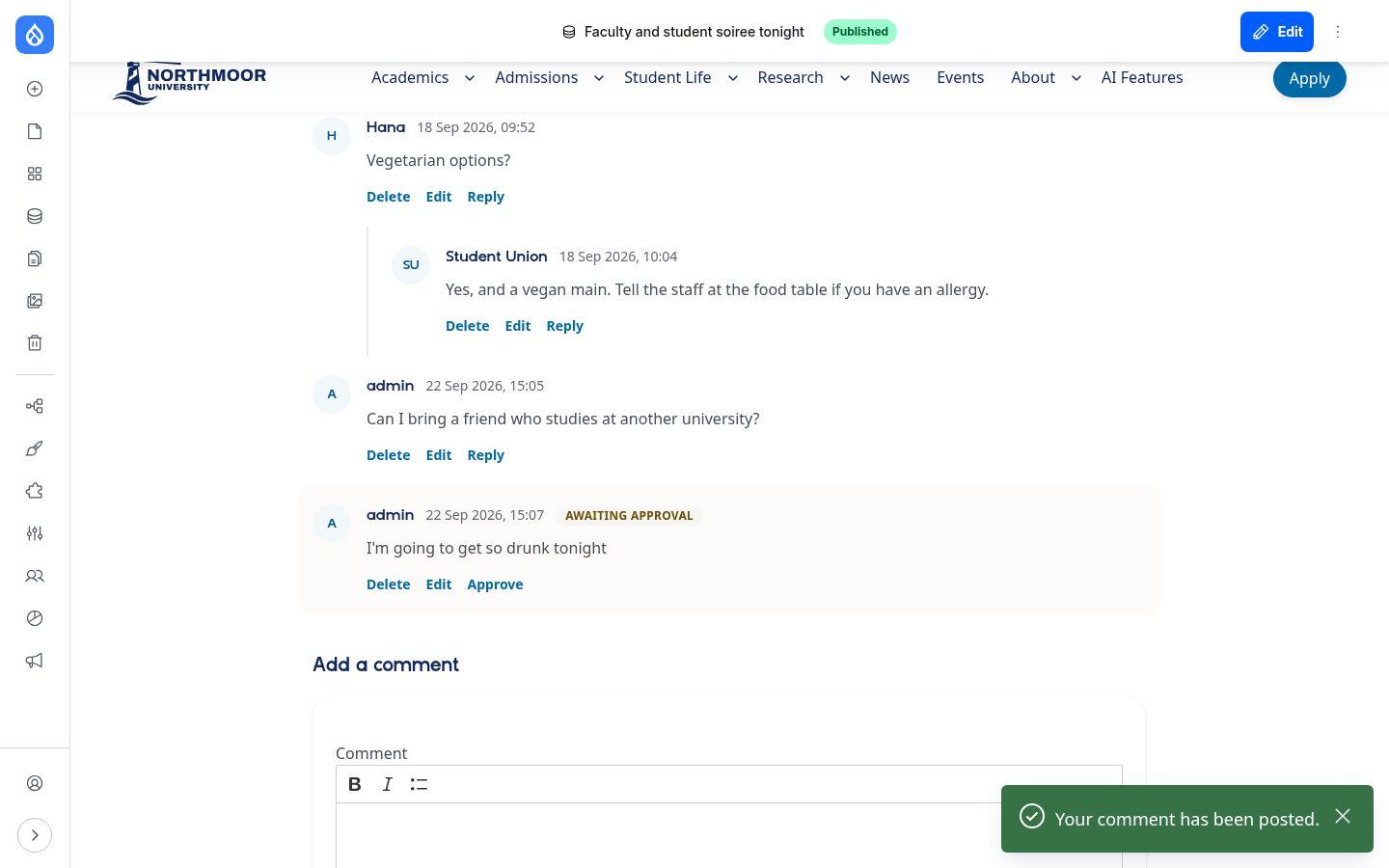
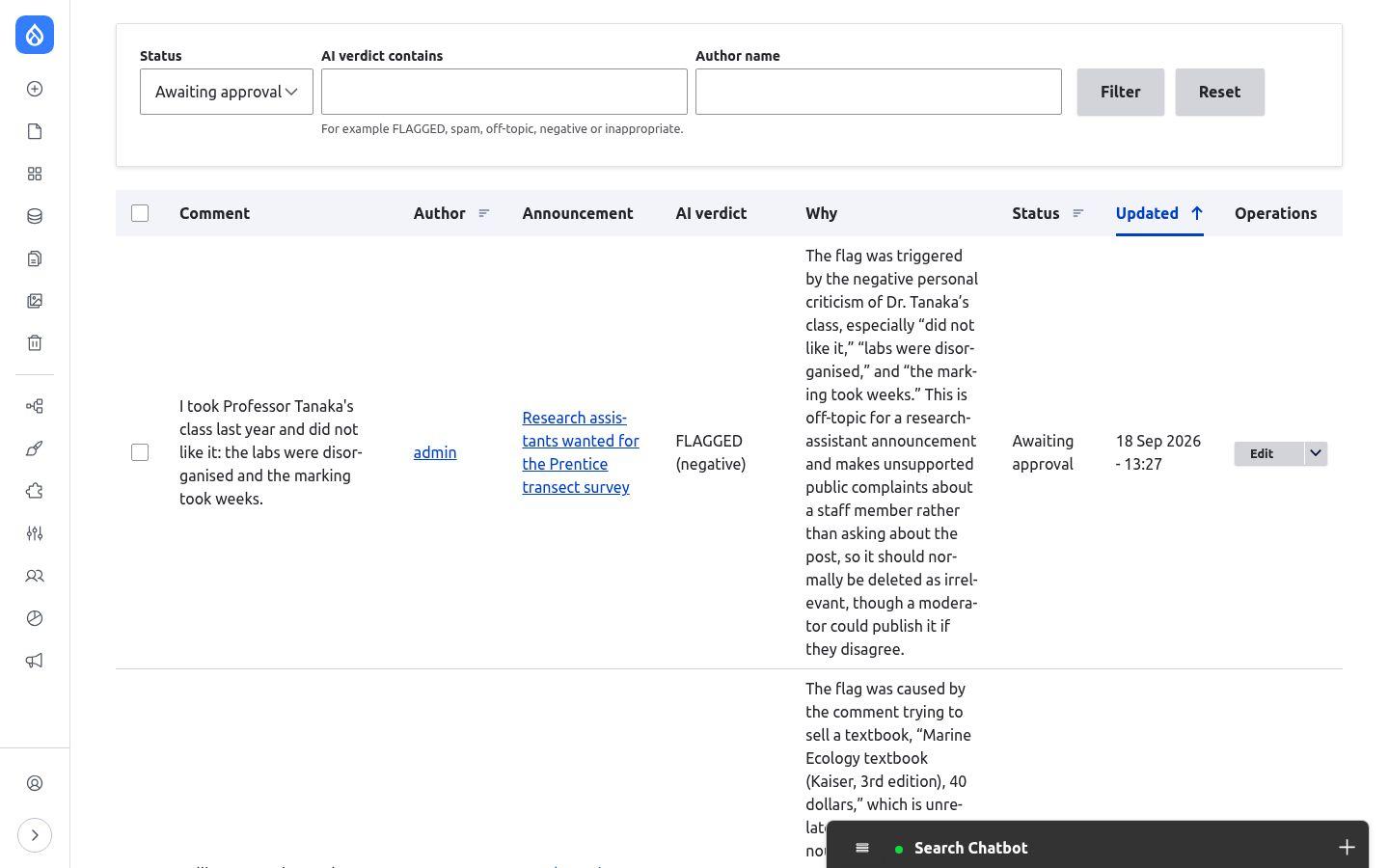
Every new comment on the demo passes three checks on its way to the database. A hard rule refuses personal attacks before anything is saved, and tells the author why. An AI automator then reads the comment together with the announcement it was posted under and answers OK or FLAGGED (spam, off-topic, negative or inappropriate), and a second automator writes two sentences for the moderator explaining the verdict. A workflow publishes the OK comments on the spot and holds the rest.
The same textbook offer is held under a party announcement and published on the selling board: the decision is about context, not keywords.
Moderators see only what was held
A moderation list shows the held comments with the verdict and the model's explanation, ready to publish or delete in bulk. The automators only fill in an empty verdict, so a moderator's decision is never overwritten.
None of it is specific to comments. The same validation rules, automators and workflow attach to any text field on any entity: a webform submission, a user biography, a document description. Deterministic rules, such as a regular expression for the correct spelling of your brand, sit next to the AI rules.
Proven in production: one brand voice across 35 sources
We built a tailored version of this for the European Travel Commission (ETC) and the Official Travel Portal of Europe. Content from 35 national tourism organisations, each with its own voice, had to read as one brand. Our solution reviews and scores content against the portal's editorial guidelines, explains every verdict and proposes rewrites, and we are contributing what we learned back to the AI Content Review module.
We presented the project at DrupalCon Rotterdam 2026. Watch the recording of the session, "One brand voice, 35 sources":
How it works, and why it stays yours
- Review rules as configuration. A review rule maps criteria to content types. Each criterion has a prompt, pass and warn thresholds and a set of scored example texts the model is calibrated against. Change the examples and the scores follow your taste, not the model's.
- Reviews stored per revision. Every run is saved with the revision it graded, which gives you a history per page and the red, amber and green overview across the site.
- Validation rules, automators and workflows. Pre-moderation is built from three standard pieces: a validation rule set that can refuse a save, AI automators that fill a verdict and an explanation field, and an ECA workflow that publishes or holds. Each piece is reusable on any entity and any field.
- Any model, including your own. Drupal AI integrates 48 providers, among them OpenAI, Anthropic, Google Gemini, Mistral, AWS Bedrock and Azure, as well as local models through Ollama or LM Studio for content that must not leave your infrastructure.
- Costs and logs in view. Every request is logged and token usage is metered per user and per role inside Drupal, so you know what a site-wide review costs before you run it. See AI Observability and AI Metering on the demo.
- Built with the community. We contribute to the AI Content Review module as part of our work in the Drupal AI Initiative.
Try it on the demo, then talk to us
Post a comment on the demo site and watch it be published or held, then tell us which rules your own content needs. We start from your style guide and your moderation policy, and we take care of the model choice, the thresholds and the controls around it.